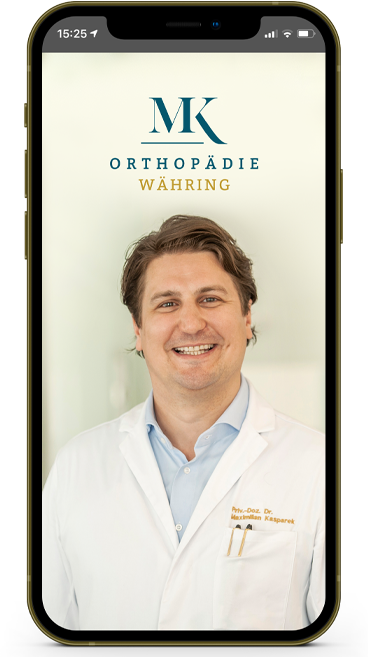

Elbow + Hand Specialist
Orthopedist Vienna
Your specialist for elbow and hand in Vienna.
Injuries and diseases of the elbow and hand not only cause pain, but also significantly affect our everyday lives. Since we use our hands daily for various tasks and for communication, limitations in their function often have far-reaching effects on our lives.
Elbow and hand complaints
Pain in the hands and elbows can manifest itself in different ways – both during movement and at rest, during the day or at night. Numbness, tingling or burning are common accompanying symptoms.
Common causes of elbow pain:
- Tennis elbow (Epicondylitis radialis humeri)
- Golfer’s elbow (Epicondylitis ulnaris humeri)
- Nerve compression syndrome of the ulnar nerve (ulnar sulcus syndrome)
Common causes of hand pain:
-
Rhizarthrosis (osteoarthritis of the carpometacarpal joint of the thumb)
-
Finger joint arthrosis
-
Tenosynovitis
-
Dupuytren’s contractures
-
Ganglia
-
Carpal tunnel syndrome (CTS, nerve compression syndrome of the median nerve)
A detailed examination is key to identifying the cause of the pain and determining the best possible therapy. The earlier the diagnosis is made, the faster and more efficiently you can be helped.
Do not wait too long, because the sooner the causes of your elbow and hand pain are diagnosed, the sooner and more effectively I, as your hand and elbow specialist, can help you!
Diagnosis and Treatment Methods
To diagnose pain in the elbow and hand, a thorough clinical examination is performed first. Additionally, X‑ray examinations and, if necessary, an MRI (Magnetic Resonance Imaging) can be utilized. Based on the diagnosis, a targeted therapy is initiated:
Conservative Treatments for Elbow Pain:
Specific Stretching Exercises
Conservative Treatments for Hand Pain:
Physical Therapy
Oral Medication Therapies
If conservative treatments are insufficient:
Should conservative methods not provide sufficient relief, surgical treatment may be necessary. As an elbow and hand specialist in Vienna, I am available to advise you and inform you about all available treatment options.
Your personal Elbow and Hand Specialist in Vienna 1180
I look forward to helping you restore your quality of life. Schedule an appointment for a comprehensive examination. Together, we will find the optimal solution for your condition!
FAQs
What is Tennis Elbow (Epicondylitis Humeri Radialis)?
Tennis elbow, medically known as epicondylitis humeri radialis, is a painful inflammation of the tendon attachments on the outer elbow. The cause is usually an overload of the forearm muscles, which can lead to small tears in the tendons. Those affected complain of pain on the outside of the elbow, which worsens with movement and stress. Common symptoms also include limited gripping ability and a feeling of weakness in the forearm.
Treatment: Treatment often includes conservative methods such as immobilization, physiotherapy, anti-inflammatory medication, and infiltrations. In severe cases, surgery may be necessary.
What is Golfer’s Elbow (Epicondylitis Humeri Ulnaris)
Golfer’s elbow, also called epicondylitis humeri ulnaris, is an inflammation of the tendon attachments on the inner elbow. This condition often occurs with overuse of the flexor muscles of the forearm. Those affected experience pain on the inside of the elbow, which worsens with certain movements, such as gripping or turning the forearm.
Treatment: Therapy often includes conservative measures such as rest, physiotherapy, anti-inflammatory medication, and infiltrations. If symptoms persist, surgical treatment may be considered.
What is Carpal Tunnel Syndrome (CTS)?
Carpal tunnel syndrome (CTS) is a common nerve compression disorder in which the median nerve in the wrist is constricted. This leads to symptoms such as numbness, tingling, and pain in the thumb, index, and middle fingers. In advanced cases, there may also be muscle weakness and wasting in the thenar eminence. The symptoms often occur at night or with certain hand movements.
Treatment: Treatment ranges from conservative methods such as wrist splints, physiotherapy, and anti-inflammatory medication to surgical procedures in which the carpal tunnel is widened to reduce pressure on the nerve.
What is Trigger Finger (Stenosing Tenosynovitis/Digitus Saltans)?
Trigger finger, also known as stenosing tenosynovitis, is a condition in which the flexor tendons of the fingers are blocked by thickened tendon sheaths. This causes the affected finger to lock in a bent position and can only be straightened again with a “snap.” Causes are often overuse or repetitive movements.
Treatment: Treatment includes conservative measures such as immobilization, anti-inflammatory medication, and injections. In persistent cases, surgery may be necessary to widen the tendon sheaths.
What is a Ganglion?
A ganglion, colloquially known as a hygroma, is a benign, fluid-filled cyst that occurs near joints or tendons. Ganglia often occur on the wrist or fingers and can cause pain, tenderness, or restricted movement, although they are often painless.
Treatment: Treatment ranges from conservative methods such as immobilization and puncture to remove the fluid to surgical removal of the ganglion if it causes discomfort or recurs.
What is Rhizarthrosis (Arthrosis of the Thumb Carpometacarpal Joint)?
Rhizarthrosis is a form of arthrosis that affects the carpometacarpal joint of the thumb. It is caused by wear and tear of the articular cartilage, which leads to pain, swelling, and restricted mobility. Those affected often have difficulty with gripping movements and experience pain at the base of the thumb.
Treatment: Therapy includes conservative measures such as splints, physiotherapy, anti-inflammatory medication, and injections. In severe cases, surgery, such as joint fusion or joint replacement, may be necessary.