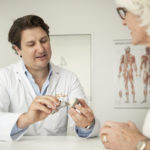
Priv.-Doz. Dr. Maximilian Kasparek, MSc in Kurier
New surgical method to enable a life like before knee arthrosis
Doctors at the Evangelical Hospital in Vienna have developed an innovative method that takes individual anatomy into account.
In the course of a human life, the cartilage in the knee joint is subject to heavy stress: it constantly cushions movements and is exposed to friction from the bones. It is therefore not surprising that arthrosis, especially knee arthrosis, is one of the most common chronic diseases in the population.
If the joint is completely destroyed, a joint replacement becomes necessary. However, patient reports show that after such an operation, they often find their artificial knee to be unnatural or suffer from pain.
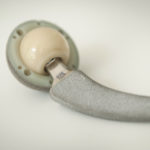
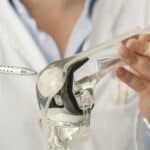
That could now change. At the Evangelical Hospital in Vienna, a new minimally invasive surgical method has been used for several months for the implantation of artificial knee joints. The goal: patients should then be able to walk and run again just as they did before knee arthrosis.
How does it work? The motto is “back to the origin,” says Primar Thomas Müllner, Head of the Departments of Orthopedics and Traumatology. Together with Dr. Maximilian Kasparek, specialist in orthopedics and traumatology, he has developed the new surgical method, which is now expected to enable major advances in the field of artificial knee joint replacement.
Essentially, the method is based on international research results showing that every knee is different and a completely straight leg is not the natural norm. However, this individual anatomy has not been taken into account in most cases to date. “We are now reconstructing the individual biomechanics and anatomy of our patients for the first time, as it was before the knee arthrosis – in other words, we are going back to the origin to enable our patients to live a life like before the arthrosis,” says Müllner.
3‑D navigation
This is made possible by the use of state-of-the-art technology: “By means of three-dimensional navigation, the necessary bone cuts for the artificial knee joint are made with millimeter precision. The individual band tension and obliquity of the natural joint line are taken into account,” the doctors describe.
The significant advantage of this method compared to other comparable methods is that conventional knee prosthesis implants can be used. In addition, additional interventions on the soft tissues, which were often necessary in the past to bring the knee into an unnatural target area of a straight leg, are no longer necessary with the new technology.
Müllner and Kasparek are very satisfied with the preliminary results: “Since the introduction of this new surgical technique, we have been able to observe that our patients have significantly less pain immediately after the operation and quickly show very good mobility,” says Kasparek. “We are now seeing the first short-term results and many patients report that their artificial knee joint feels like it did 20 or 30 years ago, when they had no pain,” reports Müllner.