
Rapid Recovery with Gelenksfitplus+: Early Mobilization After Hip or Knee Replacement
Priv.-Doz. DDr. Maximilian Kasparek, MSc is a senior physician in the Department of Orthopedics and Traumatology at the Evangelisches Krankenhaus Wien and specializes in hip and knee endoprosthetics. In his private practice in Vienna 1180, he advises patients on the choice of suitable joint replacement, the surgical procedure, and post-operative treatment.
Dr. Kasparek on Gelenksfitplus+:
“Gelenksfitplus+ does not mean that healing is rushed. The key is a clearly coordinated treatment pathway that supports early mobilization while considering individual safety.”
What does Gelenksfitplus+ mean for joint surgery?
In medicine, the terms Fast Track or ERAS are often used for this. ERAS stands for “Enhanced Recovery After Surgery.”
It does not refer to a single technique. What is crucial is the interplay of many coordinated measures before, during, and after the procedure. International ERAS recommendations include good patient information, suitable anesthesia procedures, multimodal – i.e., consisting of several components – pain therapy, and early mobilization. No single surgical approach, no specific implant, and no technical support can replace the entire treatment pathway.
What is the Gelenksfitplus+ program?
Gelenksfitplus+ is the standardized Fast Track or ERAS treatment pathway for planned hip and knee replacements at the Evangelisches Krankenhaus Wien. The program has been in use there since 2025. It comprises four central elements:
- standardized preparation before surgery,
- evidence-based anesthesia and pain concepts,
- consistent, guided early mobilization starting on the day of surgery, if medically possible,
- close interdisciplinary cooperation among the medical team, anesthesia, nursing, physiotherapy, and other involved professional groups.
According to internal program documentation, approximately 300 patients who underwent hip or knee replacement surgery were included in the ongoing evaluation project by July 2026. The evaluation examines, among other things, length of stay, early mobilization, complications, readmissions, and resource utilization.

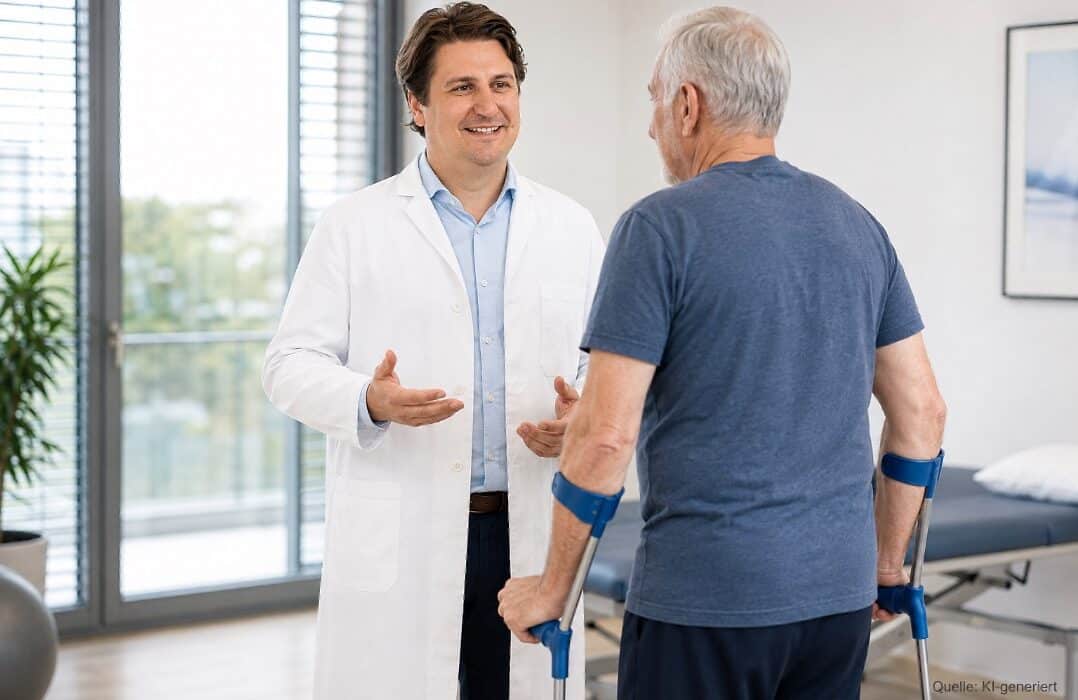
Gelenksfitplus+ combines preparation, surgery, early mobilization, and safe discharge planning.
Source: AI-generated.
What is the process for my new hip or knee joint with Gelenksfitplus+?
1. Preparation before surgery
The treatment pathway begins even before the day of surgery. Patients receive clear information about the procedure, mobilization, and the time thereafter. Pre-existing conditions, medications, anesthesia risks, and personal life situation are taken into account. Which examinations or preparatory measures are necessary is determined individually.
2. Surgery, anesthesia, and pain therapy
Surgical procedures, implants, and anesthesia are chosen to match the diagnosis and personal circumstances. A coordinated pain concept aims to adequately control discomfort while enabling early movement. “Multimodal” means that various measures are combined instead of relying solely on a single painkiller.
3. First mobilization on the day of surgery
If circulation, pain, and general condition allow, mobilization begins on the day of surgery. Under guidance, safe movement sequences are practiced first: sitting up, standing up, walking short distances with a suitable walking aid, and managing everyday transfers. If mobilization on the same day is not possible for medical or organizational reasons, it will be adjusted accordingly. This is not a failure of the program.
4. Discharge based on functional criteria
Gelenksfitplus+ does not set a fixed discharge day for everyone. The decisive factor is whether the medical and functional requirements are met. These may include stable circulation, adequately controlled pain, an unremarkable wound, as well as safe walking and the necessary daily movements. Home care and the further rehabilitation plan are also included.
What advantages can a Fast Track program have?
Well-implemented ERAS programs can support early functional recovery and avoid unnecessary delays in the treatment process. International studies and guidelines show that early rehabilitation can shorten hospital stays. A structured process also improves coordination among professional groups and actively involves patients.
It is important to classify correctly: “faster” does not mean that healing is forced or risks disappear. It is about implementing evidence-based measures at the right time and planning discharge only when it is medically justifiable.
Is Gelenksfitplus+ suitable for all patients?
Gelenksfitplus+ is aimed at patients with a planned hip or knee replacement. Whether all elements can be implemented as intended depends, among other things, on the general health status, comorbidities, initial physical condition, the specific procedure, and the post-operative course.
Advanced age alone does not automatically exclude a structured treatment pathway. However, adjustments may be necessary in cases of increased medical risk, limited mobility, or lack of support at home. The decision is always made individually by the treating team.
What Gelenksfitplus+ does not mean
- No discharge at any cost: Safety and functional criteria take precedence.
- No pain-free status from day one: Discomfort after surgery is possible and will be treated.
- No uniform weight-bearing for everyone: How much weight can be placed on the operated leg depends on the procedure and the doctor’s instructions.
- No substitute for follow-up treatment and rehabilitation: Exercises, check-ups, and a gradual increase in load remain important.
- No guarantee for a specific course: Recovery and length of stay can vary individually.
The suitable hip or knee prosthesis remains an individual decision
Gelenksfitplus+ describes the entire treatment pathway, not the selection of a specific prosthesis. Whether a joint replacement is even advisable for advanced hip osteoarthritis or knee osteoarthritis depends on the diagnosis, symptoms, age, activity level, comorbidities, and individual circumstances. If a prosthesis is indicated, a total joint replacement, a partial prosthesis, or other procedures may be considered, depending on the findings. Minimally invasive approaches for hip prostheses, as well as navigation or surgical robots for knee prostheses, are not used indiscriminately but are chosen according to medical indication.
Consultation on hip or knee prosthesis in Vienna
If you are considering a hip or knee prosthesis, you can discuss the diagnosis, possible alternatives, the suitable surgical procedure, and the rehabilitation process calmly in a surgical consultation. This also applies if you have already received a recommendation for surgery and would like a second opinion.
Frequently Asked Questions (FAQ) about Gelenksfitplus+
What is the difference between Gelenksfitplus+, Fast Track, and ERAS?
The terms are often used similarly in the context of joint replacement. They refer to a coordinated treatment pathway that supports recovery around the surgery. ERAS is the English abbreviation for “Enhanced Recovery After Surgery.” Gelenksfitplus+ is the specific program name at the Evangelisches Krankenhaus Wien.
Is Gelenksfitplus+ a new surgical method?
No. Gelenksfitplus+ is not a single surgical procedure. It combines preparation, anesthesia and pain therapy, surgery, nursing, physiotherapy, early mobilization, and discharge planning into a standardized process.
For which operations is Gelenksfitplus+ used?
The program is used at the Evangelisches Krankenhaus Wien for planned hip and knee endoprosthetics. Which prosthesis and which surgical procedure are suitable is decided individually, independently of the program.
Do I have to get up on the day of surgery?
Early mobilization is an essential component. It begins on the day of surgery if the medical condition allows. Circulatory problems, nausea, pain, or other reasons may necessitate an adjustment.
Will I be pain-free after a Gelenksfitplus+ operation?
No, pain-free status cannot be promised. The goal is adequately effective, individually tailored pain therapy so that movement is possible and side effects are kept to a minimum.
Does Gelenksfitplus+ mean I have to go home the next day?
No. There is no mandatory discharge date for everyone. Discharge occurs when medical and functional criteria are met and further care is arranged.
Am I allowed to fully bear weight on the operated leg immediately?
This cannot be derived solely from the term Gelenksfitplus+. The permitted weight-bearing depends on the procedure, the stability of the implant, and the individual medical instructions.
Is Gelenksfitplus+ also possible for older people?
Advanced age alone is not an automatic exclusion criterion. Health status, mobility, comorbidities, and personal risk are decisive. The treatment pathway will be adjusted accordingly.
What can I do to prepare myself?
Follow the specific instructions of the treatment team, fully disclose medications and pre-existing conditions, and arrange support for the initial period at home. Which exercises or further measures are useful should be discussed individually.
Where can I get advice on Gelenksfitplus+ and joint replacement?
Priv.-Doz. DDr. Maximilian Kasparek, MSc provides advice in his private practice at Med18 Ordinationszentrum, Theresiengasse 46/2, 1180 Vienna. Surgery and the inpatient treatment pathway are planned – if medically indicated – at the Evangelisches Krankenhaus Wien.
Medical Disclaimer
This article serves for general information and does not replace a personal medical examination or consultation. Which treatment, surgery, weight-bearing, and aftercare are suitable must be determined individually.
If you enjoyed this article, you might also be interested in other posts from our blog.