

Use of an artificial joint: “Cori” robot now assists with knee surgery
Highest precision
Around 23,000 artificial knee joints are implanted in Austria every year. Patient satisfaction after the operation is primarily based on optimal planning and execution of the procedure. Now, a robot-assisted system enables even more individual and precise treatment.
An innovative, robot-assisted system has been used for the first time in Austria at the Evangelical Hospital-Vienna since the beginning of February. The CORI system, described by surgeons as a “robotic team member,” enables the measurement, planning and execution of a procedure fully tailored to the patient’s individual anatomy and lifestyle, as explained by Head of Orthopedics, Prim. Univ.-Doz. Dr. Thomas Müllner.
How does the “robotic team member” work?
Based on a CT scan, a detailed plan for the operation is created, tailored to the patient’s anatomy. This data is taken over by “Cori”, whose centerpiece is a high-speed milling machine, and implements the specifications with the highest precision.
For example, the robot system automatically stops the surgeon’s hand as soon as enough bone material has been removed. This prevents unnecessary bone wear and, for the first time, enables precise modeling of the recess for the artificial joint to the nearest tenth of a millimeter.
The advantages for patients are diverse. “This precision also allows the bone to fuse better with the implant. The result is a highly stable artificial joint, an optimized fit and thus a longer lifespan, less pain and also a more natural walking feeling in the knee,” explains orthopedic surgeon, Doz. Dr. Maximilian Kasparek.
Computer-assisted knee navigation has been used at the Evangelical Hospital for over 20 years. Prim. Müllner: “Therefore, patient satisfaction has been over 93 percent for years. We would like to improve this result for the benefit of the remaining patients with the new robot system.“
Thanks to “Cori”, the virtual representation is now even more accurate, the 3D model of the knee or the prosthesis can be rotated in the room and viewed precisely from all sides. “If necessary, fine adjustments are still made,” says the surgeon.
Initial experiences are very promising
Comparisons with conventional knee joint operations show that robot-assisted use results in a significant improvement in terms of the exact fit of the prosthesis and a natural walking feeling in the sensitive transition area between the kneecap and the thigh bone.
“The first patient experiences make us very confident that the positive study results will also be reflected in our work,” reports Prim. Müllner. And he clarifies: “The safe landing still depends on the pilots: the more experienced they are, the more successful the ‘teamwork’ with Cori, the new robot milling machine, will be.”
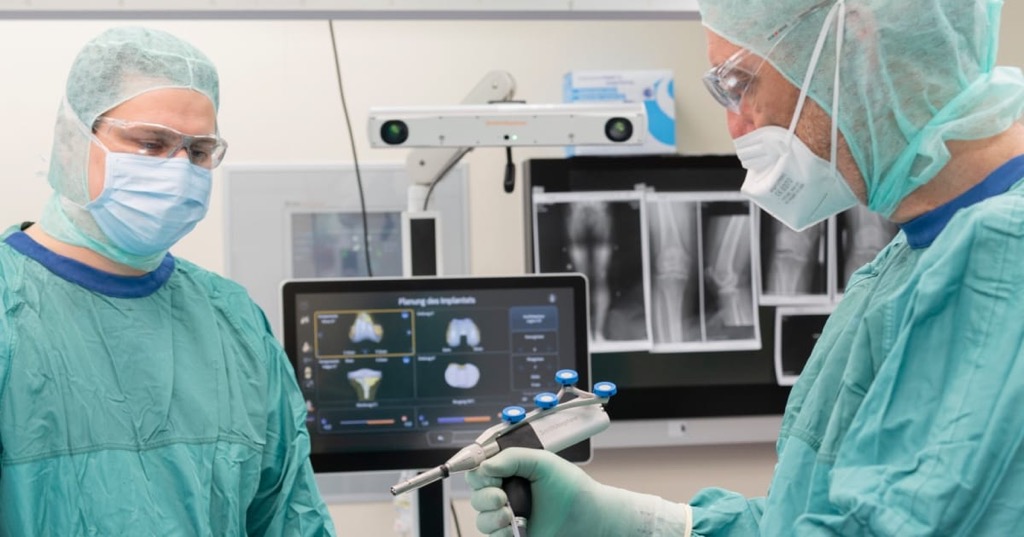
Use of an artificial joint: “Cori”, the new robot milling machine, shortly before its use in knee surgery. (Image: EKH / M. Knapp)