
Cruciate Ligament Tears in Soccer: When Is Surgery Recommended?
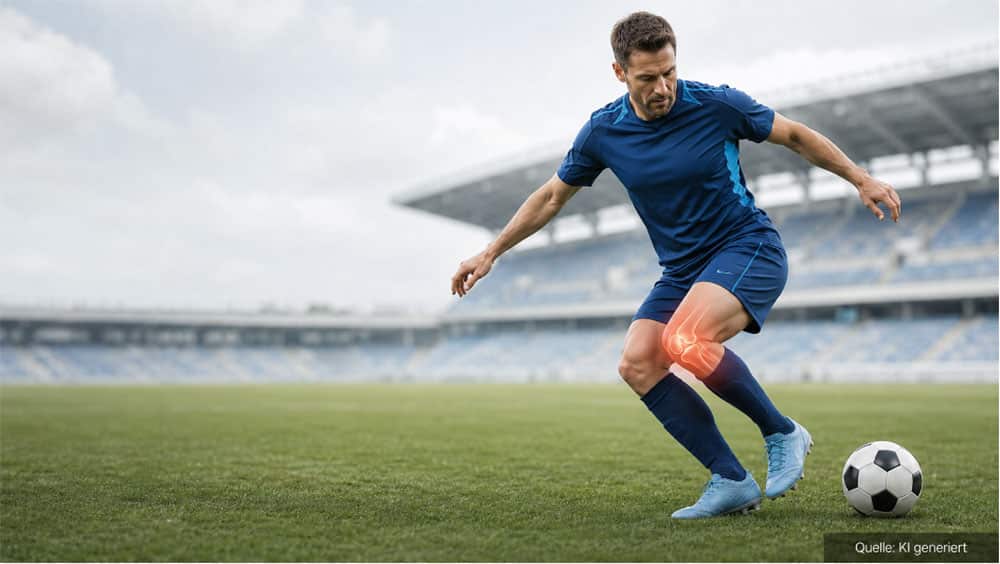
Typical mechanism of injury: The knee twists during a change of direction while the foot remains on the ground. Image source: Generated by AI.
Why do cruciate ligaments tear so often in soccer?
The anterior cruciate ligament stabilizes the knee joint. It prevents the lower leg from shifting too far forward relative to the thigh and controls rotational movements.
Many cruciate ligament tears occur without direct contact with an opponent. Typical situations include:
- a sudden twisting motion while keeping one foot planted
- abrupt stopping or a quick change in direction
- an uncontrolled landing after a jump
- a duel or a clash
- hyperextension or severe twisting of the knee
Some people who are affected hear or feel a popping sound. The knee often swells within a short time and feels unstable. However, a torn cruciate ligament can also present with less obvious symptoms. Therefore, just because someone can keep walking after twisting their knee doesn’t automatically mean they only have a minor strain.
Cruciate Ligament Tears and Meniscus Tears: A Common Combination
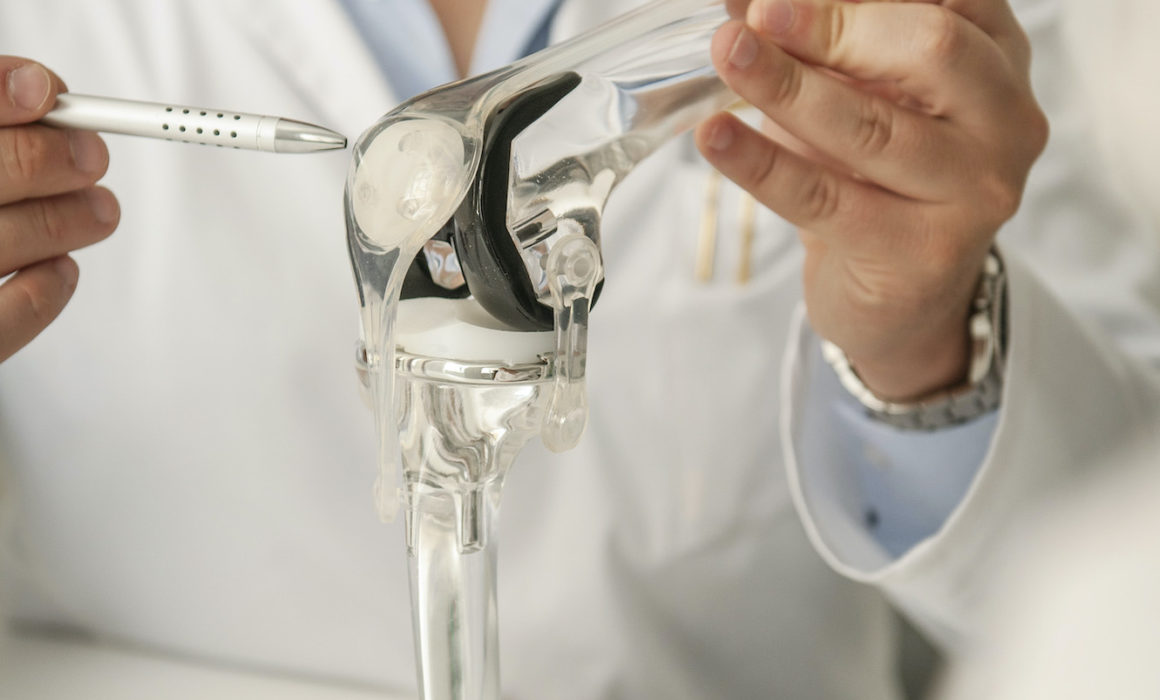
During the same twisting motion, the medial or lateral meniscus and the articular cartilage can be injured in addition to the cruciate ligament. The meniscus distributes the load in the knee and acts as a shock absorber. A tear can cause pain along the joint space, swelling, a feeling of catching, or a locking sensation.
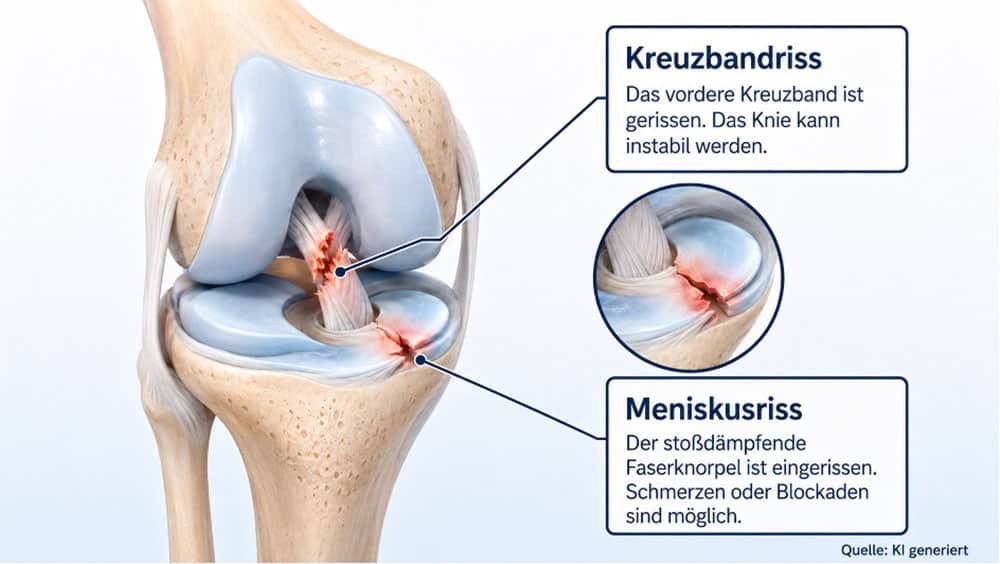
Cruciate ligament tears and meniscus tears explained simply. Image source: AI-generated.
The treatment depends on whether only the cruciate ligament is affected or whether the meniscus or cartilage is also involved. The evaluation typically includes a discussion of the circumstances of the injury, a clinical examination with stability and meniscus tests, and magnetic resonance imaging (MRI). The MRI findings are always evaluated in conjunction with the patient’s symptoms, stability, and athletic goals.
Does a torn cruciate ligament always require surgery?
No. A torn cruciate ligament does not automatically require surgery. If the knee is stable during everyday activities and the patient’s athletic demands are minimal, a structured conservative treatment plan involving physical therapy may be appropriate.
However, soccer places high demands on the knee: sprinting, sudden stops, twisting movements, and one-on-one battles all require reliable stability. Cruciate ligament surgery may be a particularly good option if:
- the knee repeatedly buckles during sports or everyday activities
- there is significant instability
- the goal is to return to soccer
- there is additional damage to the meniscus or cartilage
- the patient is young or very active in sports
- the instability persists despite targeted physical therapy
Age isn’t the only factor. Even recreational soccer players can place high demands on their knees. That’s why injury patterns, training volume, position, occupation, and personal goals are all taken into account in the decision-making process.
What happens during cruciate ligament surgery?
In a cruciate ligament reconstruction, the torn anterior cruciate ligament is typically replaced with a tendon graft. The procedure is performed arthroscopically—that is, using a minimally invasive technique through small incisions. A camera allows for a precise assessment of the knee joint. At the same time, meniscus or cartilage damage can be treated.
The graft is placed as close as possible to the original position of the cruciate ligament and secured to the thighbone and shinbone. The goal is a stable, functionally sound knee—but the surgery is only one part of the treatment. Consistent rehabilitation is just as important.
Which tendon is suitable for cruciate ligament reconstruction?
Various tendons from the patient’s own body can be used for the reconstruction, such as tendons from the back of the thigh, the quadriceps tendon, or a portion of the patellar tendon. In certain situations, donor tissue may also be an option.
Each option has its advantages and disadvantages. The choice depends, among other things, on age, activity level, type of sport, work-related stress, anatomy, and any previous surgeries. For young, athletically active patients, a tendon from the patient’s own body is often preferred. However, there is no single graft that is the best choice for everyone.
It is therefore important to develop a personalized treatment plan with a surgeon who specializes in knee surgery. This plan takes into account not only stability and load-bearing capacity, but also potential discomfort at the donor site and the demands of future athletic activities.
What happens if a meniscus tears at the same time?
Whether a meniscus tear is sutured or partially removed depends on the type of tear, its location, size, blood supply, and tissue quality.
Meniscus Suture
If the tear can be successfully repaired, the meniscus is preserved and sutured whenever possible. This is particularly important for younger and physically active patients because the meniscus protects the articular cartilage over the long term. However, after suturing, the tissue must heal; therefore, the process of gradually resuming weight-bearing may take longer.
Minimally Invasive Meniscus Resection
If a damaged section can no longer be sutured securely, it may be necessary to remove only as much tissue as possible. In this procedure, only tissue that cannot be preserved is removed, and as much healthy meniscus as possible is preserved. More information: Meniscus Tears and Meniscus Surgery in Vienna
When is surgery performed after a cruciate ligament tear?
Planned cruciate ligament reconstruction usually does not need to be performed immediately on the day of the accident. Often, the knee should first be allowed to recover from swelling and regain its range of motion. Physical therapy before surgery can improve range of motion and muscle control.
Certain associated injuries may require earlier surgery—for example, a displaced meniscal tear that causes the knee to lock. The appropriate timing is determined based on swelling, range of motion, muscle strength, associated injuries, and occupational and athletic demands.
How does rehabilitation work?
After surgery, the grafted tendon needs time to heal firmly into the knee. At the same time, range of motion, muscle strength, and stability are gradually rebuilt. How quickly the exercise regimen can be increased depends on the type of surgery and any additional injuries—such as a meniscus tear. The exact course of rehabilitation depends on the procedure and any accompanying injuries.
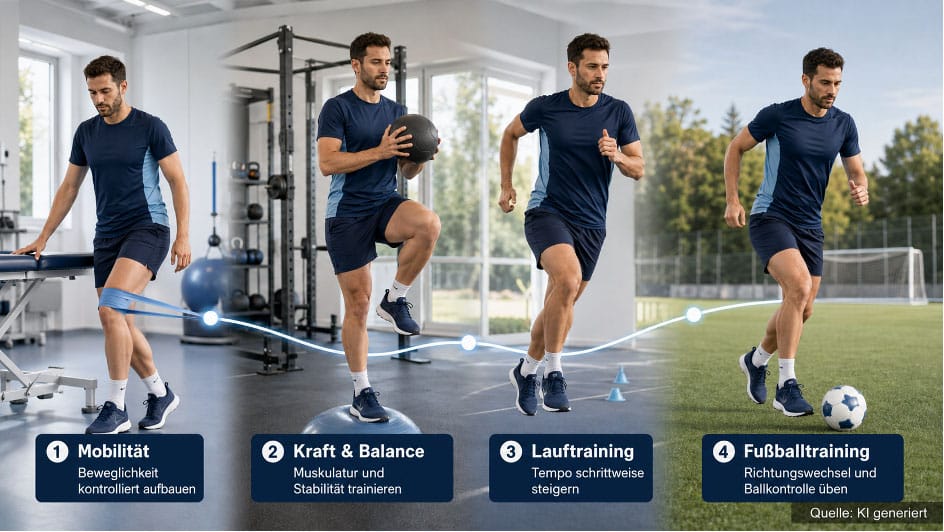
Four typical stages of rehabilitation: mobility, strength and balance, running training, and soccer-specific training. Image source: Generated by AI.
- Reduce swelling and gradually restore mobility in a controlled manner
- Improve Strength and Muscle Control
- Train balance, stability, and proper leg alignment
- Gradually increase your running workload
- Practice jumps, changes of direction, and soccer-specific movements
- Return to team practice in a controlled manner
- Clearance for one-on-one drills and competition following functional tests
After additional meniscus suturing, more conservative guidelines regarding weight-bearing and range of motion are often recommended. Therefore, the rehabilitation plan should always be tailored to the injury as a whole and the specific surgical procedure.
When can I play soccer again?
A return to soccer should not depend solely on a specific date. Before returning to the sport, the knee should be free of irritation and flexible, the muscles should be sufficiently developed, and the player should have successfully passed tests involving running, jumping, and changes of direction. Confidence in the knee also plays an important role.
If there are no complications, a full return to a sport involving rapid changes in direction and contact with opponents often occurs no sooner than about nine months, and in some cases later. Returning to sports too soon can increase the risk of re-injury. Therefore, clearance should be based on specific criteria and determined by the treating physician and the rehabilitation team.
Why is the surgeon’s experience important?
Several factors are crucial in cruciate ligament reconstruction: the selection of an appropriate graft, its anatomical positioning and secure fixation, as well as the identification and treatment of any accompanying meniscus or cartilage damage.
Priv.-Doz. DDr. Maximilian Kasparek, MSc specializes in knee surgery and sports injuries. As a board-certified specialist in orthopedics and traumatology and an IOC sports physician, he takes into account not only the nature of the injury but also his patients’ athletic goals. Treatment is planned on an individual basis—from the initial examination through the decision for or against surgery to the gradual return to sports.
Get a cruciate ligament tear or meniscus tear checked out if it happened while playing soccer
Did you twist your knee while playing soccer, suffer a torn cruciate ligament or meniscus, or would you like a second opinion on a recommended surgery?
At the private practice of Priv.-Doz. DDr. Maximilian Kasparek, MSc, located in 1180 Vienna, your test results, any possible accompanying injuries, and your athletic goals will be carefully evaluated. Together, we will decide whether conservative treatment is possible or which surgical method is best suited to your situation.
Frequently asked questions (FAQ)
Can you still walk with a torn ACL?
Yes. Many people who have torn a cruciate ligament can still walk. However, that doesn’t mean the knee is stable enough. Rotational movements, sudden stops, and soccer, in particular, can cause the knee to give way.
Can I keep playing soccer with a torn ACL?
Soccer is generally not recommended for people with an unstable knee. Repeated buckling can cause further damage to the meniscus and cartilage. Whether a return to play without surgery is realistic must be determined on a case-by-case basis.
Does a recreational soccer player need surgery for a torn cruciate ligament?
Not automatically. The key factors are stability, symptoms, associated injuries, and the desired level of activity. However, anyone who wants to play soccer regularly places high demands on their knee.
Can the cruciate ligament and meniscus be operated on at the same time?
Yes. If there is also a meniscus tear that requires treatment, it can often be sutured or partially removed during the same minimally invasive surgery.
Is meniscus suturing better than partial meniscectomy?
If suturing is a viable option, preserving the meniscus is generally desirable. However, not every tear is suitable for this approach. If the tissue cannot be preserved, a minimally invasive partial removal may be necessary.
Which tendon is best for cruciate ligament reconstruction?
There is no single tendon that is equally optimal for all patients. Age, type of sport, occupational demands, anatomy, and prior surgeries all influence the choice.
How soon should a torn cruciate ligament be examined?
A severely swollen, unstable, or locked knee should be examined promptly. In cases of a locked knee, severe pain, or an inability to bear weight, prompt medical evaluation is particularly important.
How long is the recovery time after a cruciate ligament tear in soccer?
After cruciate ligament reconstruction, it often takes at least nine months to return to soccer without restrictions. Depending on the healing process, any accompanying injuries, and the results of functional tests, the recovery period may be longer.
For more information:
If you enjoyed this article, you might also be interested in other posts from our blog.